Passenger Pigeon
Ectopistes migratorius
Columbiformes - Columbidae - Ectopistes
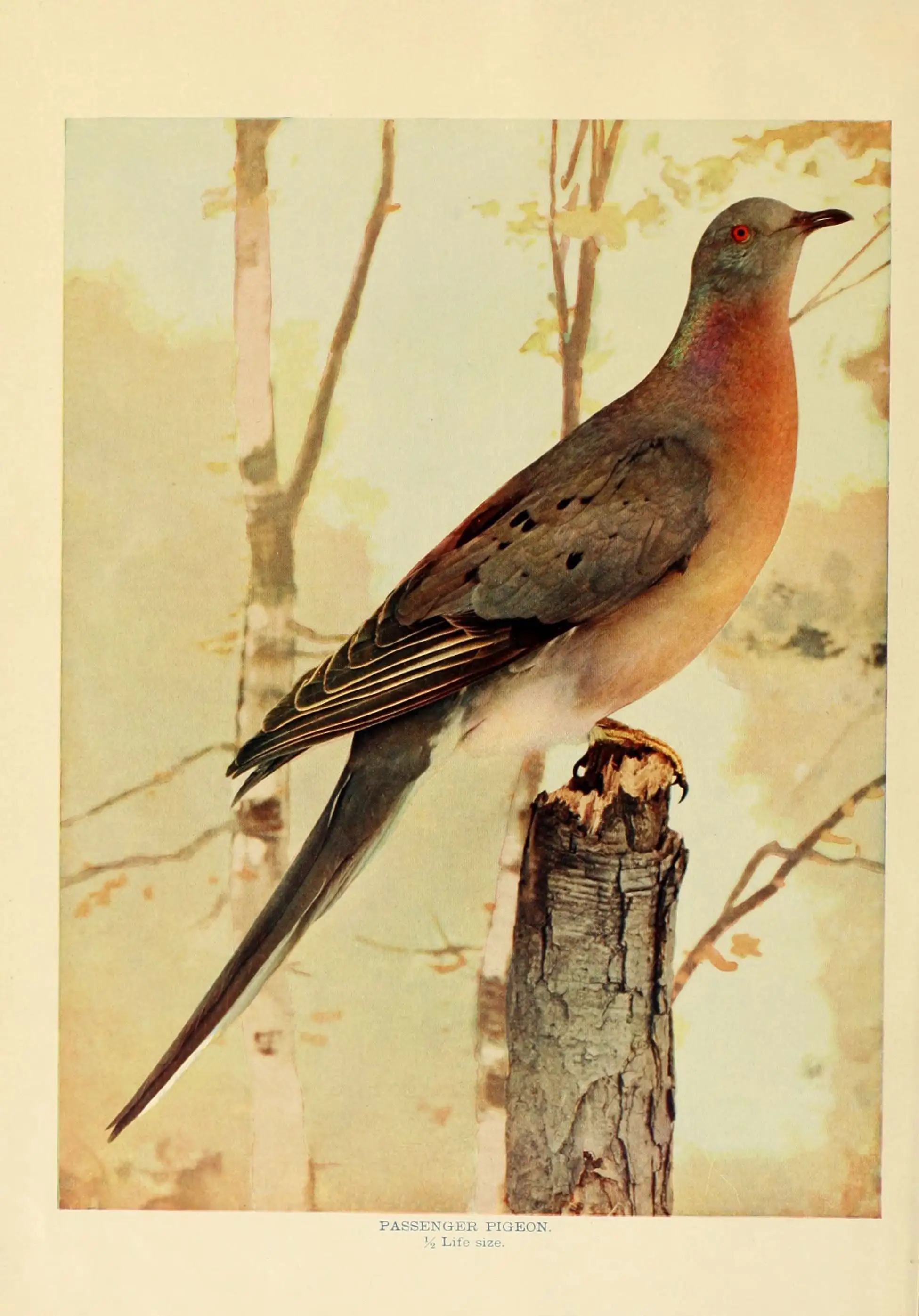
The Passenger Pigeon was a pigeon native to eastern North America, and the only species in its genus. Research on DNA from museum specimens has shown that about 12 million years ago, the Passenger Pigeon shared a common ancestor with a group of North American pigeons now placed in the New World pigeon genus, including living species such as the Band-tailed Pigeon, but later diverged quite substantially at the genetic level1.
The Passenger Pigeon was about 40 centimeters long, larger than any pigeon now living in North America, including the Band-tailed Pigeon, the largest of them. By comparison, the Rock Pigeon commonly seen in cities is usually just over 30 centimeters in length. The species was sexually dimorphic. Males were bluish gray from the head to the back, with a cinnamon-buff breast and belly. Females were similar in pattern but duller overall, and slightly smaller than the males.
The Passenger Pigeon was once extraordinarily abundant. Its total population may have reached several billion, making it not only the most numerous wild bird ever known from North America, but quite possibly the largest bird population the world has ever seen. It could fly at speeds of up to 100 kilometers an hour, and often gathered in immense nomadic flocks that moved from place to place in search of suitable broadleaf forests. There they fed primarily on acorns, beech nuts, and other hardwood mast, and nested, bred, and raised their young in the trees. Passenger Pigeons bred in spring and laid just one egg at a time.
In the second half of the nineteenth century, large-scale commercial hunting targeting their enormous nesting colonies caused the population to collapse sharply. Their numbers eventually fell below the level needed to sustain their highly social way of life and their predator satiation-based survival strategy, pushing the species toward extinction. After the 1870s, following the failure of several large-scale nesting attempts in the Great Lakes region, broken up by hunters who descended on the colonies, the Passenger Pigeon became increasingly scarce. But people continued to kill them whenever they gathered to nest, and this finally drove the species from the wild. The last wild record supported by definite physical evidence dates to March 12, 19012, when a male Passenger Pigeon was shot near the town of Oakford, Illinois.
The last Passenger Pigeon, Martha, died at 1 p.m. on September 1, 1914, at the Cincinnati Zoo. Her exact age is unknown, but she was likely more than twenty years old, and the figure most often accepted is twenty-nine3.
-
Soares AER, Novak BJ, Haile J, Heupink TH, Fjeldså J, Gilbert MTP, Poinar H, Church GM, Shapiro B. 2016. Complete mitochondrial genomes of living and extinct pigeons revise the timing of the columbiform radiation. BMC Evolutionary Biology. 16(1). doi:https://doi.org/10.1186/s12862-016-0800-3. ↩︎
-
Some sources say March 25th. See: Greenberg, Joel, A Feathered River across the Sky, Bloomsbury Publishing USA, 2014. ↩︎
-
Cokinos C. 2009. Hope Is the Thing With Feathers. Penguin. ↩︎